Culture: Difference between revisions
m saıram etymo, Jemu is historical |
→Food: added images for two food items Tags: Mobile edit Mobile web edit |
||
| (16 intermediate revisions by 10 users not shown) | |||
| Line 2: | Line 2: | ||
== Geography == | == Geography == | ||
Toaqgua (" | Toaqgua ("Toaqland") is located somewhere within Southeast Asia. | ||
Lanao is the biggest city and business capital. The second-largest is Saqmeı ("Three Mountains"). Kuaoce ("Cyanport") is the administrative capital but it's much smaller. | |||
There also exists Mıaodoaq, an underground city located under one of the mountains of Saqmeı City.<!-- There should be something about the new month names here. --> | |||
== Rituals and Traditions == | == Rituals and Traditions == | ||
Every | Every 22nd of April, the people of Toaqgua light paper lanterns and float them down a river to celebrate the joys of life and celebrate memories shared with loved ones. This tradition is believed to originate from the town of Fegıodoaq ("the town of 5 lights"). The food festivals can be found all across Toaqgua at this time, with many families choosing to share their regional cuisines or passed down recipes. | ||
== Mythology == | == Mythology == | ||
The ancient people of Toaqgua believed in [[Jemu]], Toaq's whale-moth hybrid legendary creature and mascot, who brings good luck and provides strength to those who need it. | The ancient people of Toaqgua believed in [[Jemu]], Toaq's whale-moth hybrid legendary creature and mascot, who brings good luck and provides strength to those who need it. | ||
== Fashion == | |||
Traditionally, mummy-like linen wrappings used to be worn covering the arms and sometimes also legs and torso, called {{t|Sarashı}}. In modern times, these have fallen out of fashion, and have seen a resurgence as a subculture centered around their aesthetic, wearing them them under clothes that would otherwise be revealing. | |||
== Food == | == Food == | ||
{{t|Cıereıtaq}} (literally "fish roll") is a dish made of tilapia, carrots, and cabbage wrapped in a light rice paper, served with a sweet durian-based sauce. | {{t|Cıereıtaq}} (literally "fish roll") is a dish made of tilapia, carrots, and cabbage wrapped in a light rice paper, served with a sweet durian-based sauce. | ||
{{t|Saıram}} is a stew comprising | {{t|Saıram}} is a stew comprising braised beef, carrots, chillies, cilantro, and wine. | ||
Its name may derive from {{t|seaı}} "alcohol" or {{t|saı}} "stuff" (ingredients) or {{t|caı}} "strong", and the frequentative prefix {{t|ram-}} as in {{t|rạmloeq}} "to simmer". | |||
{{t|Beomnam}} ("hearty bread") is a Toaqguan flatbread-based street food. It is either layered or stuffed with a spiced mayo, ground beef, chopped mushrooms, green onions (and sometimes caramelized onions), and a crumbly cheese. | |||
{{t|Mıaobubua}} ("moon-porridge") is a rice porridge notable for its light colour and pleasant smell, which it gets from fragrant ingredients like garlic, ginger, and onion. | |||
It's served in round bowls with no garnish, its white colour representing that of the full moon, and is only eaten during religious rites. | |||
{{t|Zanasaoza}} is a popular Toaqguan condiment. It's a thick sauce consisting of fish or soy sauce, lime juice, a starch slurry for thickness, and various other ingredients, often garlic, onion, and vegetables like carrot. | |||
It can be diluted to make a dipping sauce, added to other dishes to enhance the flavour, or eaten with rice or flatbread. | |||
It's sold premade and packaged, but many still choose to prepare it themselves. | |||
Many recipes exist, so most restaurants have their own style of making Zanasaoza. | |||
<gallery> | |||
File:Ciereitaq.jpg|thumb|A platter of cıereıtaq | |||
File:Sairam.jpg|caption|A portion of saıram | |||
File:Beomnam.jpg|caption|A dish with beomnam | |||
File:Beomnam2.jpg|caption|Another beomnam | |||
File:Miaobubua.jpg|caption|mıaobubua served with zanasaoza, broccoli and tofu | |||
File:Zanasaoza.jpg|caption|zanasaoza garnished with green onion | |||
</gallery> | |||
Latest revision as of 07:28, 22 September 2025
This page serves to document the community-created culture for a fictional Toaq country (Toaqgua).
Geography
Toaqgua ("Toaqland") is located somewhere within Southeast Asia.
Lanao is the biggest city and business capital. The second-largest is Saqmeı ("Three Mountains"). Kuaoce ("Cyanport") is the administrative capital but it's much smaller.
There also exists Mıaodoaq, an underground city located under one of the mountains of Saqmeı City.
Rituals and Traditions
Every 22nd of April, the people of Toaqgua light paper lanterns and float them down a river to celebrate the joys of life and celebrate memories shared with loved ones. This tradition is believed to originate from the town of Fegıodoaq ("the town of 5 lights"). The food festivals can be found all across Toaqgua at this time, with many families choosing to share their regional cuisines or passed down recipes.
Mythology
The ancient people of Toaqgua believed in Jemu, Toaq's whale-moth hybrid legendary creature and mascot, who brings good luck and provides strength to those who need it.
Fashion
Traditionally, mummy-like linen wrappings used to be worn covering the arms and sometimes also legs and torso, called Sarashı. In modern times, these have fallen out of fashion, and have seen a resurgence as a subculture centered around their aesthetic, wearing them them under clothes that would otherwise be revealing.
Food
Cıereıtaq (literally "fish roll") is a dish made of tilapia, carrots, and cabbage wrapped in a light rice paper, served with a sweet durian-based sauce.
Saıram is a stew comprising braised beef, carrots, chillies, cilantro, and wine. Its name may derive from seaı "alcohol" or saı "stuff" (ingredients) or caı "strong", and the frequentative prefix ram- as in rạmloeq "to simmer".
Beomnam ("hearty bread") is a Toaqguan flatbread-based street food. It is either layered or stuffed with a spiced mayo, ground beef, chopped mushrooms, green onions (and sometimes caramelized onions), and a crumbly cheese.
Mıaobubua ("moon-porridge") is a rice porridge notable for its light colour and pleasant smell, which it gets from fragrant ingredients like garlic, ginger, and onion. It's served in round bowls with no garnish, its white colour representing that of the full moon, and is only eaten during religious rites.
Zanasaoza is a popular Toaqguan condiment. It's a thick sauce consisting of fish or soy sauce, lime juice, a starch slurry for thickness, and various other ingredients, often garlic, onion, and vegetables like carrot. It can be diluted to make a dipping sauce, added to other dishes to enhance the flavour, or eaten with rice or flatbread. It's sold premade and packaged, but many still choose to prepare it themselves. Many recipes exist, so most restaurants have their own style of making Zanasaoza.
-
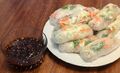 A platter of cıereıtaq
 -
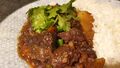 A portion of saıram
 -
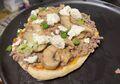 A dish with beomnam
 -
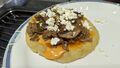 Another beomnam
 -
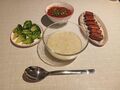 mıaobubua served with zanasaoza, broccoli and tofu
 -
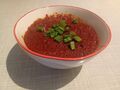 zanasaoza garnished with green onion


